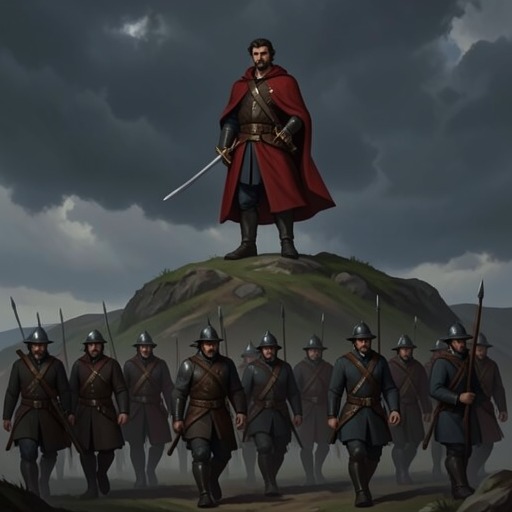
Yong Kai
The Romance of the Three KingdomsYong Kai is a governor in the southern borderlands who joins Meng Huo’s AD 225 revolt against Shu. His bid to resist the advancing Shu army ends not in a decisive battlefield defeat but in political isolation: Kong Ming exploits mistrust among the rebels until Gao Ding turns against him, and Yong Kai is killed while trying to escape. The episode makes his downfall an early demonstration of how the campaign is won through manipulation of allegiance as much as through force.
Identity and Political Setting
Yong Kai is identified as governor of Jianning, one of three local governors who join Meng Huo’s uprising. Zhu Bao, governor of Zangge, and Gao Ding, governor of Yuesui, are the other two. Their revolt comes as Meng Huo advances into the southern borderlands with a force of one hundred thousand, while the governor of Yongchang is besieged and appeals urgently for help. The governors’ alliance places Yong Kai within a broader challenge to Shu’s control, not in an independent local dispute.
The danger is sharpened by the political history between Yong Kai and Liu Zhang, governor of Yizhou. Liu Zhang has executed both Yong Kai’s mother and brother, and therefore regards him as a threat. He has already positioned a garrison at Baxi, near Hanzhong. When news of the revolt arrives, Liu Zhang is alarmed and calls his advisers together. The account thus presents Yong Kai’s rebellion against a background of existing hostility and the instability of the southern frontier.
The Governors’ Revolt and Kong Ming’s Counterstrategy
Kong Ming leads a Shu expedition south, accompanied by commanders including Zhao Zilong, Wei Yan, and Wang Ping. Early in the campaign, Wei Yan captures E Huan, a commander serving Gao Ding. Rather than punish him, Kong Ming treats him respectfully and sends him back with a message: Gao Ding is a loyal man misled by Yong Kai and should surrender. The offer is designed to detach Gao Ding from the rebel alliance, and Yong Kai immediately recognizes its political danger. He warns Gao Ding that Kong Ming’s leniency is a scheme to divide and rule.
Yong Kai responds by attacking the Shu army, but the first assault fails and his forces are badly defeated. He attacks again the next day, only to be held off. A few days later, Yong Kai renews the attack alongside Gao Ding, who has returned to the rebels; again the Shu army prevails, and many soldiers are captured. These repeated reversals leave the coalition vulnerable to the very suspicion Kong Ming has encouraged.
Kong Ming separates the captured soldiers according to their original groups and spreads the rumor that Gao Ding’s men will be spared while Yong Kai’s will be executed. When questioned, the prisoners from Yong Kai’s ranks claim to have served Gao Ding, and Kong Ming releases them as he has the others. He adds a second falsehood: that someone from Yong Kai’s camp has offered to secure pardon by bringing him the heads of Gao Ding and Zhu Bao. The freed soldiers carry the resulting uncertainty back to the rebel camps, where it increases Gao Ding’s anxiety.
Isolation, Death, and the End of the Revolt
Still undecided about surrender, Gao Ding sends a spy into the Shu camp. Kong Ming has the spy captured, then pretends to mistake him for a messenger from Yong Kai. He demands the heads of Gao Ding and Zhu Bao and sends the confused spy back with a fabricated letter urging his supposed master to act before it is too late. The message has the intended effect: Gao Ding concludes that he must kill Yong Kai and surrender to Kong Ming.
Gao Ding and E Huan plan to kill Yong Kai at a banquet. When Yong Kai does not appear, Gao Ding interprets his absence as evidence of a plot and attacks Yong Kai’s camp with E Huan. Many of the defenders are the same soldiers Kong Ming had released after they claimed to be Gao Ding’s men; they now join Gao Ding. Yong Kai escapes at first, but E Huan later kills him in an ambush. His end is therefore caused by the collapse of his alliance and the Shu strategist’s careful use of misinformation, not simply by the earlier defeats in battle.
Gao Ding brings Yong Kai’s head to Kong Ming with both his own men and Yong Kai’s former soldiers. Kong Ming then feigns distrust, claiming that Zhu Bao has secretly offered to surrender and has warned him that Gao Ding and Yong Kai were inseparable. He demands Zhu Bao’s head as proof of Gao Ding’s loyalty. Gao Ding and E Huan kill Zhu Bao, whose forces then submit. With the three governors’ revolt broken, Kong Ming appoints Gao Ding governor of all three areas and makes E Huan commander of his troops.
Narrative Significance
Yong Kai’s role is brief but central to the mechanics of the campaign’s opening. He understands that Kong Ming is trying to split the rebel leaders, yet his repeated attacks do not restore unity; instead, defeat, the release of prisoners, and manufactured rumors deepen Gao Ding’s suspicion. The irony is that Yong Kai correctly identifies the strategy but cannot prevent it from working.
His death also marks the transition from the governors’ revolt to the larger confrontation with Meng Huo. News that the revolt has been suppressed reaches Meng Huo, who calls the chieftains of three valleys together and seeks to unite them against Shu. Yong Kai’s removal thus clears the immediate political obstacle to Kong Ming’s next phase of the southern campaign, while showing how the account links military advance to the reshaping of local authority through surrender and appointment.